4-Chloroaniline
4-Chloroaniline is an organochlorine compound with the formula ClC6H4NH2. This pale yellow solid is one of the three isomers of chloroaniline.
 | |
| Names | |
|---|---|
| Preferred IUPAC name
4-Chloroaniline[1] | |
| Systematic IUPAC name
4-Chlorobenzenamine[1] | |
| Other names
p-Chloroaniline | |
| Identifiers | |
3D model (JSmol) |
|
| 471359 | |
| ChEBI | |
| ChEMBL | |
| ChemSpider | |
| ECHA InfoCard | 100.003.093  |
| KEGG | |
PubChem CID |
|
| RTECS number |
|
| UNII | |
| UN number | 2018 |
CompTox Dashboard (EPA) |
|
| |
| |
| Properties | |
| ClC6H4NH2 | |
| Appearance | Pale yellow solid |
| Density | 1.43 g/cm3 |
| Melting point | 72.5 °C (162.5 °F; 345.6 K) |
| Boiling point | 232 °C (450 °F; 505 K) |
| 2.6 g/L at 20 °C[2] | |
| Hazards | |
| Main hazards | Very toxic, possible carcinogen. Absorbed through skin.[3] |
| Safety data sheet | External MSDS |
| GHS pictograms |  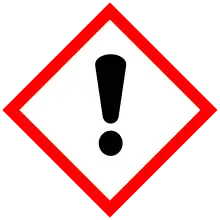 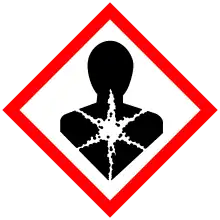 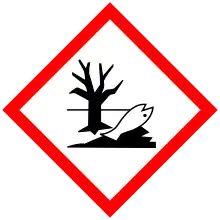 |
| GHS Signal word | Danger |
| H301, H311, H317, H331, H350, H400, H410 | |
| P201, P202, P261, P264, P270, P271, P272, P273, P280, P281, P301+310, P302+352, P304+340, P308+313, P311, P312, P321, P322, P330, P333+313, P361, P363, P391, P403+233, P405 | |
| Flash point | 113 °C (235 °F; 386 K) |
Except where otherwise noted, data are given for materials in their standard state (at 25 °C [77 °F], 100 kPa). | |
 verify (what is verify (what is  ?) ?) | |
| Infobox references | |
Preparation
4-Chloroaniline is not prepared from aniline, which tends to overchlorinate. Instead, it is prepared by reduction of 4-nitrochlorobenzene, which in turn is prepared by nitration of chlorobenzene.[4]
Uses
4-Chloroaniline is used in the industrial production of pesticides, drugs, and dyestuffs. It is a precursor to the widely used antimicrobial and bacteriocide chlorhexidine and is used in the manufacture of pesticides, including pyraclostrobin, anilofos, monolinuron, and chlorphthalim.[5] 4-Chloroaniline can be also used in the manufacture of some benzodiazepine drugs as well as the antihistamine dorastine, the antiarhythmic lorcainide, and the antifungal ontianil.
4-Chloroaniline can exhibit antimicrobial action against some bacteria and molds.[4]
References
- Nomenclature of Organic Chemistry : IUPAC Recommendations and Preferred Names 2013 (Blue Book). Cambridge: The Royal Society of Chemistry. 2014. p. 669. doi:10.1039/9781849733069-FP001. ISBN 978-0-85404-182-4.
- Scheunert, 1981
- "Safety data for 4-chloroaniline". Oxford University. Archived from the original on 2012-04-23. Retrieved 2008-03-11.
- Gerald Booth (2007). "Nitro Compounds, Aromatic". Ullmann's Encyclopedia of Industrial Chemistry. Weinheim: Wiley-VCH. doi:10.1002/14356007.a17_411.
- Ashford’s Dictionary of Industrial Chemicals (3rd ed.). 2011. p. 1998.