David Hancocks
David Hancocks (born May 5, 1941) is a British architect and designer for zoos, aquariums, natural history museums, botanic gardens, and nature centers. Notable for having creating the Woodland Park Zoo's revolutionary gorilla exhibit, which utilized natural foliage and techniques and was dubbed an immersion exhibit, a technique which has become the often imitated standard for accredited zoos across the globe.[1]
David Hancocks | |
|---|---|
| Born | May 5, 1941 |
| Education | BCs in Archetecture & Building Engineering from University of Bath, 1966 |
| Known for | Animal Enclosure Architecture and Design |
History and early career
David Hancocks was born and raised in the United Kingdom, and graduated with a degree in Architecture & Building Engineering from the University of Bath in 1966. He was the celebrated 100,000th graduate from the university.[2] Hancocks had never visited a zoo before, but went to work at the London Zoo in order to learn animal behavioral needs for designing, but was frustrated when the zoo's architects were more interested than design and form than practicality and function.[2][3]
Work at the Woodland Park Zoo
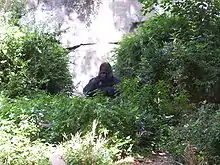
After writing the book Animals and Architecture in 1971, Hancocks was brought on to become the designer of the Woodland Park Zoo in Seattle, Washington. Hancocks hoped to take into account the physiological needs of the animals by creating a replicated version of their own environments, taking into account natural foliage and rockwork, with special consideration taken to make the exhibit acoustically pleasant and provide ample natural light. These strategies and techniques became known as "landscape immersion." Hancocks hoped that immersing the guest and the animal in an exhibit similar to their natural environment would help them recognize the vital links between wild animals and their habitats, allowing guests to come to the realization that the best way to help animals is to preserve their wild habitats.[3] The first example of landscape immersion was implemented in July of 1979, in the zoo's gorilla enclosure.[4]
The techniques were met with ample criticism at first. Zoo experts were concerned about the cost of replacing the exhibit's real foliage, as well as Seattle's weather negatively affecting the soil seasonally. Zoo-goers were frustrated at not being able to see the gorillas at all times, with them being able to hide behind foliage and in their holding areas at whim.[3] Eventually, academics and directors from other zoos began to take notice and implement such features in their enclosures, such as then-director Terry Maple of Zoo Atlanta, and Bernard Harrison from the Singapore Zoo. It would take approximately 12 years for any other zoos to put the philosophy behind immersion exhibits into their enclosures.[3] After this the technique of landscape immersion exhibits became the standard for zoos, as they many would work to imitate an animal's natural environment as closely as possible, as opposed to abstracted or practical exhibits. Hancocks stayed as a design coordinator, and then director of the zoo from 1972 to 1984.[1]
Other work[1]
David Hancocks went on to become the director of Tuscon's Arizona-Sonora Desert Museum from 1989 to 1997, and became the director of the Werribee Open Range Zoo near Melbourne and then the strategic development director for Zoos Victoria, encompassing the Healsville Sanctuary, the Melbourne Zoo and the Werribee Open Range Zoo from 1998 to 2003. Hancocks also wrote the book A Different Nature: The Paradoxical World of Zoos and Their Uncertain Future in 2001 as an exploration of the history and future of zoos, using his experiences working on animal enclosures and habitats.[1]
Activism and criticism of zoos
Hancocks has become an outspoken critic of zoos and other similar institutions, claiming that they are fundamentally unchanged, advancing very little since the era of Victorian menageries, and must realize their power that must be put towards conservation and education by renovating their exhibits and changing their scope and concept.[5] To this point, Hancocks has stated his concern that zoo's focus on charismatic megafauna and focus on individual animal species, rather than their place in ecosystems as a whole, detracts from the overall message of conservation and ecology that zoos have the potential to achieve.[4][3] Hancocks equates zoos to museums by saying that both are "object-driven" as opposed to thematically "story-driven", by selecting an object or animal, and choosing how to display it, rather than selecting a path of information and choosing objects to enhance it.[5] Hancocks has stated that for zoos to achieve their potential, they must move away from simply being places that put animals on display, and instead evolve into all-encompassing natural history museums with a focus on life and animal welfare.[3] Hancocks has also stated the possibility of reducing the number of zoos in more regulated environments, and matching animals to their climates better, comparing the potential of zoos to Disney parks, and claiming that with a handful of national zoos, they could become tourist attractions that could generate more money and higher welfare for the animals, rather than many spread-out animal exhibitions with different rules and styles of management.[6]
Hancocks has also become highly critical of elephants in captivity, stating that research shows that many animals do better in captivity than elephants, and many modern zoos refuse to accept that, and instead institute breeding programs to replenish a depleting stock.[7][3][6] He notes that archetypical activities in zoo elephants, such as pacing, swaying, and even coprophagy in elephants is the result of enclosed spaces with little to no opportunity to interact with or manipulate natural objects.[8] He has been outspoken about his former employer, the Woodland Park Zoo's elephant enclosure in particular, stating that Seattle's climate and the enclosure's size are not conductive to a happy, healthy life in elephants.[9] Hancocks is an advocate for sanctuaries in climates better suited to elephants,[6] citing both the Performing Animal Welfare Society (PAWS) Sanctuary in various California facilities, and The Elephant Sanctuary in Hohenwald, Tennessee as examples of these.[7]
Hancocks is also involved with the Whale Sanctuary Project, a project that serves to create a sanctuary for performing orcas in Nova Scotia.[1]
References
- Nature, The Whale Sanctuary Project | Back to. "David Hancocks". The Whale Sanctuary Project | Back to Nature. Retrieved 2020-11-18.
- "BA2 issue 24". Issuu. Retrieved 2020-11-18.
- "David Hancocks | The Paradoxical World of Zoos". Conservation Careers. 2018-08-24. Retrieved 2020-11-18.
- "A Critical Look at the Future of Zoos--An Interview with David Hancocks". National Geographic Society Newsroom. 2012-03-13. Retrieved 2020-11-18.
- Hancocks, David (3 September 1991). "Renovate the Zoos". The Washington Post.
- Lemonick, Michael D. (2006-06-11). "Who Belongs in the Zoo?". Time. ISSN 0040-781X. Retrieved 2020-11-18.
- "The Elephant in the Room - Episodes - The Fifth Estate". Retrieved 2020-11-18.
- Hancocks, David (March 2, 1991). "Bellyache or Boredom? Letters to the editor". Science News. 9: 143 – via JSTOR.
- "Friends of Woodland Park Zoo Elephants » David Hancocks: The Future of Zoos". Retrieved 2020-11-18.