Edwin Weyburn Goodwin
Edwin Weyburn Goodwin (October 1800 - September 13, 1845) was itinerant miniature and portrait painter active in upstate New York, and father of trompe-l'oeil painter Richard La Barre Goodwin.
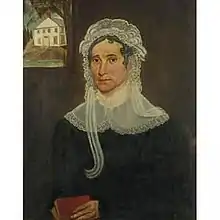
Goodwin was born in Ovid, New York and lived in Dryden, Ludlowville, Auburn, Albany and Ithaca, New York. He was largely self-educated and twice married, first to Almira Ives then to Almira LaBarre. Goodwin began his career as a merchant, but at age 29 took up painting which he later studied in New York City under Anthony Lewis De Rose; his first exhibit was at the National Academy of Design in 1836. He was an ardent abolitionist and abstinence advocate, taking ownership of The Tocsin of Liberty, an anti-slavery newspaper in Albany, around 1842, and lecturing in New York state for emancipation. His 1837 lecture "Don't Bring it into the Church," caused him to be disciplined by his Methodist Episcopal Church of Auburn, New York. Goodwin painted some 800 portraits during his career, including those of anti-slavery activists President Martin Van Buren, William H. Seward (given to the city of Albany), DeWitt Clinton, James G. Birney, and Gerrit Smith of Albany. He died in Ithaca, New York. His work is collected in the Genesee Country Village and Museum and his papers archived in the Smithsonian Institution.
References
External links
- Goodwin families in America, by John Samuel Goodwin, supplement to the William and Mary College Quarterly Historical Magazine, 1899, pages 64-65.
- Smithsonian Institution archives
- "Edwin Weyburn Goodwin (1800-1845)", Folk Portrait Artists, Peggy McClard Antiques
- Genesee Country Village & Museum NEH Application
- "Edwin Weyburn Goodwin", Seward Family Digital Archive
- The Tocsin of Liberty, snippet from the Signal of Liberty, January 26, 1842