George Soros: The Life and Times of a Messianic Billionaire
George Soros: The Life and Times of a Messianic Billionaire is a non-fiction book by Michael T. Kaufman released by Random House in 2002, that illuminates the early life, education, work, and controversial philanthropy of a man considered by many to be simultaneously one of the most enigmatic yet globally influential financiers of our era.
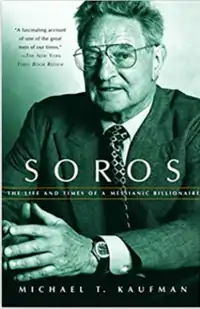 First edition cover | |
| Author | Michael T. Kaufman |
|---|---|
| Country | New York, USA |
| Language | English |
| Subject | The life, work, and philanthropy of George Soros |
| Genre | Nonfiction |
| Publisher | Random House |
Publication date | 2002 |
| Media type | Print (hardback) |
| Pages | 344 |
| ISBN | 9-780-37570549-6 |
Synopsys
A poor immigrant who made an immense fortune and became one of the more controversial yet largest contributing philanthropists of the twentieth century, George Soros has led a unique place in modern history. As the first biography of Soros, and written with greater depth due to his cooperation, Kaufman's work begins with Soros's childhood as a Jew in his birthplace of Budapest, Hungary, during first the German and subsequent Russian occupations in World War II. It follows him through his education at the London School of Economics, to his unprecedented success on Wall Street after his move to America, and details his reasons for establishing his philanthropic Open Society foundations.[1]
The novel provides exclusive insights into the life of a man formerly mysterious and misunderstood, whose struggle to escape the Nazis and survive their occupation, strongly contributed to his primary philanthropic goal of using existing organizations, and internal grass roots activism to take actions he believed would reduce restrictions on freedom of speech, and promote education, economic growth, scientific progress, and civil liberties in nations throughout the world. Toward that end, his Open Society Foundation, which he began in later life and whose name he based on Karl Popper's 1945 opus, The Open Society and its Enemies, has contributed around $32 billion, the vast majority of his wealth, to countries throughout the world to promote civil liberties and economic growth.[1]
As of May 2020, Soros had a net worth of $8.3 billion,[2][3] having donated more than $32 billion to the Open Society Foundations,[4] of which $15 billion have already been distributed, representing 64% of his original fortune, making him the "most generous giver" in terms of percentage of net worth according to Forbes.[5] In more recent years he has contributed to approximately 200 political action groups, most of them operating in the United States. It should be strongly noted that his detractors, particularly in the countries where his organizations have been active often question his motives, achievements, and methods.[1]
Outspoken often to a fault, and sometimes appearing contradictory, Soros has arguably become one of the most globally influential men of the last thirty years. In his well researched and deeply insightful work, Michael T. Kaufman casts a broad light on a formerly mysterious life, and reveals both Soros's motivations, and despite some controversy, what he views as Soros's considerable contributions to the countries where his foundations are active.[1]
The novel describes Soros's difficult times as an outsider in London after fleeing Budapest. Though he received an exceptional education at the London School of Economics (LSE), as a non-resident he was required to partially finance his education through odd jobs including working as a railway porter and as a night-club waiter. While at the LSE, he received a Bachelors of Arts, a Masters, and later received a Doctorate from the University of London. At LSE, he was briefly mentored by Karl Popper who made a lifelong impression. His work as a London salesman, and stock trader, is detailed before his fortuitous move to New York to work for F. M. Myer on Wall Street. Between 1969 and 1997 he operated his own hedge fund, initially named Double Eagle, and later the Soros fund. Eventually named the Quantum Fund, it has had the largest growth, and became the most profitable of its kind in the late twentieth century. His Theory of Reflexivity, borrowed from Popper, states in simplest terms that a person cannot fully know reality, as his own actions continuously alter it in continuous feedback loops. The same concept is applied to his investment theory and he advises investors to strongly consider how other investors and outside influences affect the market and cause market trends which must be carefully analyzed and occasionally tend toward a full boom or a full bust.[1]
Nobel prize nominee
Significantly, as Kaufman notes in his section "Giving It Away", despite his numerous detractors, Soros has more than once been recommended for the Nobel Peace Prize, and one of the beneficiaries of his foundations, Amnesty International, received the award in 1977. He had been formally nominated for the award in several years of the late 1990's, and numerous influential Russian leaders have recommended him for it, most notably Mikhail Gorbachev.[6][1][7]
Work in Russia
Chapter 19 of Soros's book notes that though Soros is still strongly criticized by Vladimir Putin in contemporary Russia, due to Soros's efforts during Glasnost in the 1980s, and 1990's Mikhail Gorbachev recommended Soros for the Nobel Peace Prize for giving grants of $100 million to Soviet scientists when the state had no money to pay them, giving $100 million to free the teachings of Humanities in Universities from their adherence to Marxism–Leninism, contributing funds to promote health care and fight disease, and most notably spending $100 million for all thirty-three regional Universities in Russia to connect to the Internet. Soros also gave additional millions to elementary and secondary schools for textbooks and libraries.[8]
Central European University
In September 1991, funded entirely on his own, and staffed with globally recognized academics, Soros's founded Central European University with its first campus in Prague, Czechoslovakia with other campuses in Budapest, Hungary and Warsaw, Poland. In 2018, the central campus moved from Budapest to Vienna, Austria, forced to leave by ruling Prime Minister Viktor Orban, as a result of a judicial decision that caused public protest in Hungary, and that was opposed by a subsequent ruling of the European Court of Justice.[9] By 2019, it had graduated 16,000 students. Soros's annual gift to operate the University reached 20 million dollars, and his personal total endowment is approximated at $880 million.[10][11]
Philanthropy and detractors
Additional narratives on his personal life and Soros's efforts to further human rights in Hungary, China, and Russia, complete the final section of Kaufman's biography. Soros's foundations were highly active in opposing Apartheid in South Africa, and in countering what Soros viewed as the restraints on economic growth or reduction in civil liberties posed by Soviet influence in many Eastern European countries including first his native Hungary, then Poland, Czechoslovakia, Lithuania, and the Balkans. For his work in his native Hungary towards his efforts to modernize the country, Soros was presented with the Medium Cross of Hungary's Republican Order with Stars, the country's second-highest decoration.[12]
By the early 90's Soros's foundations were active in eighteen countries including Romania, Bulgaria, Yugoslavia, and the new states of Ukraine, Belarus, Moldavia, Georgia, Kazakhstan, Uzbekistan, Kyrgyzstan, and Turkistan. When Yugoslavia broke apart, new foundations came into being in Croatia, Slovenia, Macedonia and Bosnia.[13] In smaller efforts, Soros supported pro-democracy movements in Burma, and school construction projects in Albania.[14]
Today Soros's Open Society Foundations support freedom and democracy initiatives in over 100 countries around the world.[15] The efforts of Soros's foundations have often faced major political opposition and harsh criticism in many of these countries.
Black Wednesday
As noted by Kaufman, in England, where Soros's hedge funds profited up to a billion dollars from speculating on the value of the Pound Sterling, Soros's hedge fund was for a period heavily criticized for damaging the British economy as a result of his speculation on the likely devaluation of the English Pound on September 16, 1992, the date now known as "Black Wednesday".
Converting Pounds to German Marks
In simple terms, Soros, on behalf of his hedge fund, and backed by a multitude of co-investors in his firm, acquired and sold around ten billion British Pounds, converting the majority into German Marks which would hold steady against the Pound. A considerable number of investors around the world privately began selling off the Pound as well. A majority of the $10 Billion pounds which he primarily sold for Marks had been borrowed against the assets he held in his Quantum Fund. When the Pound was devalued around 10-15 % against the German Mark on September 16, Soros realized a considerable profit of around $1 Billion.
Balancing the criticism by many British financial analysts that this move damaged the English economy, Kaufman noted that Soros had previously invested heavily in British securities during this period, and during the earlier nationalization of industries imposed by Margaret Thatcher around 1984, Soros's funds were heavily invested in English securities including Jaguar automobiles, and around $20 million in British Telecom.[16] According to one reliable source Soros invested $500 million in British stocks shortly before "Black Wednesday" in the first few weeks of September 1992, based on the assumption that a countries equities would rise following the devaluation of its currency.[17] The Queen herself, noted Kaufman, had invested in the Quantum Fund and negative feelings towards Soros would soon be moderated by a growing population segment that admired Soros's foresight and intellect, and admitted their country's use of a currency backed by the precious metal silver was becoming an outmoded form of exchange. Investopedia, an online economic sight has written "that economic policies enacted in the U.K. in the aftermath of that day (Black Wednesday) contributed to an improvement in economic growth, lower unemployment, and less inflation."[18][19][20]
Shortly prior to the currency speculation of "Black Wednesday", the British pound was required to trade at a level of about 2.95 German marks. A "fixed rate" system. Soros believed and many British economists eventually agreed that "Fixed exchange rate systems were flawed, because they eventually fall apart. In fact any fixed exchange rate system is flawed and the longer it exists, the greater the flaws become. The only escape is to have no exchange rate system at all, but a single currency in Europe as in the U.S." As noted by Kaufman, unlike most other speculators or men of wealth, Soros used his considerable profit to further invest in economic development and education in other countries, and most heavily in Russia, where he felt economic growth and democratic freedoms were most at risk.[19]
As Soros has admitted, at times a small portion of his contributions may have been pocketed by their recipients or used privately by those who should have been administering his foundations, and others have found his positive changes to be cut short when a new Presidential administration or opposing political movement gains power. [21] In China in 1989, though he made a valiant effort to support economic growth and back anti-Communist dissidents, the Open Society Foundation was forced to close due to the rigidity of its Communist bureaucracy and opposition from leaders such as Chairman Deng Xiaoping who associated the group with a competing political faction. In China in 1987, as in several other Communist nations, Soros's Open Society Foundation was erroneously suspected of being tied to efforts of America's Central Intelligence Agency to undermine Communism or export China's technological secrets.[22]
Project on Death in America
After the death of his father in 1968, Soros felt strongly that the elderly should, if at all possible, be given the opportunity to die at home on their own terms, as the majority wished to die, according to polls. He promoted, but did not seek to legislate, that those dying in great pain of terminal illnesses be given the opportunity to discuss ending their lives with their children and legal counsel. Soros was strongly criticized by many conservatives for discussing the right of a segment of the elderly population to discuss their option to end their lives when there was no way of ending their pain and little or medical help that might extend their lives. In 1993, Soros held a meeting of experts to discuss what would become known as the Project on Death in America.[23]
Strongest opponents

To add depth to his writing, Kaufman noted Soros's global opponents and dealt objectively in describing some of Soros's American critics, though it should be mentioned that Kaufman is fundamentally a supporter of Soros in general, perhaps most strongly because of the depth and scale of Soros's philanthropic efforts through his foundations, and directly through his own efforts. Kaufman noted that most of Soros's strongest European and Asian opponents were at one point identified as autocrats, and usually dictatorial leaders who stifled the opposition press, and feared the influence of outsiders who might open the way to reform. As Kaufman noted, Soros has "in fact crossed rhetorical swords with a sizable portion of the world's autocrats, dictators, and despots".[24] [25]
Slobodan Milosevic, Yugoslavia
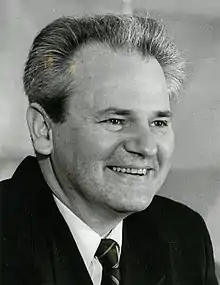
Kaufman observed that Soros has openly feuded with and been denounced by the former Serbian and Yugoslavian President, Slobodan Milosevic who attempted to have Soros's foundation evicted for their support of independent media. Milosevic was charged with war crimes in 1999 by an international tribunal and had stifled the opposition press during periods of his administration.[25]
Franjo Tudjman, Croatia
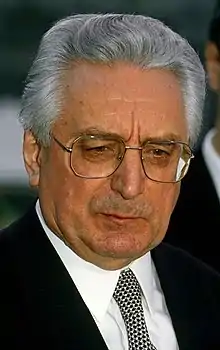
In Croatia, where Soros's foundations also provided economic support, Franjo Tudjman, a nationalistic leader, attempted to punish Soros's Zagreb-based foundation by bringing suits against those providing grants. The Open Foundation's conflict likely centered with the nature of Tudjman's tenure as president during which he was criticized as authoritarian by some observers.[26][27] At least one political observer viewed Tudjman's post-war policies negatively, remarking that "between healthy nationalism and chauvinism, he chose chauvinism; between free-market economy and clientelism, he chose the latter. Instead of the cult of freedom, he chose the cult of the state.[28]
Aleksandr Lukashenko, Belarus
In Belarus, Communist leader Aleksandr Lukashenko forced the closure of Soros's Minsk foundation by promising to bring criminal investigations into its staff. In 2001 the BBC referred to Belarus under Lukashenko as "Europe's last dictatorship", and criticized Lukashenko for not hosting free elections or maintaining robust freedom of the press.[29]
Vladimir Meciar, Slovakia
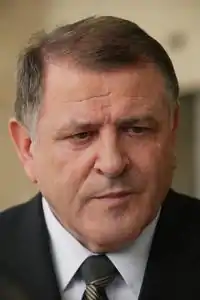
In Slovakia, Vladimir Meciar, accused of authoritarian styles of leadership in the 1990's, used the press to defame Soros with anti-Semitic slurs similar to those that had formerly been used in Hungary. In Russia, Soros may have erred in criticizing wealthy oligarch Boris Berezovsky, whom he truly considered dangerous to Russia due to his political stands and possible financial corruption. Always outspoken, his criticism also extended to members of Boris Yeltsin's family. Soros was in turn targeted by media attacks likely initiated by Berezovsky and Yeltsin, though Soros was admired and his causes usually endorsed by Mikail Gorbachev. In total, at least prior to Putin's administration in Russia, Soros's foundations have faced less criticism than in many other nations, and the actions taken by Yeltsin, and his successors have been relatively moderate.[30]
United States
In the United States, Kaufman noted that Soros has come under attack frequently by leaders of the country's "war on drugs", who abhor his attempts to deal with narcotics as a public health rather than a criminal problem and have attacked him for supporting referendums in five states to legalize the use of marijuana for medicinal purposes. More recent opposition has been by critics who believe his foundations have provided funding to support the campaigns of judges and attorney generals they consider soft on crime.
In August of 2009, after the book's publication, Soros donated $35 million to the state of New York to be earmarked for underprivileged children and given to parents who had benefit cards at the rate of $200 per child aged 3 through 17, with no limit as to the number of children that qualified. An additional $140 million was put into the fund by the state of New York from money they had received from the 2009 federal recovery act. Soros's late turn to more clearly charitable contributions, though earlier work opening universities and providing scholarships should also be seen as primarily charitable, may have been a result of controversies caused by his donations to American political candidates who were Democrats, particularly presidential candidates.[31]
Mahathir Mohamad, Malaysia
.jpg.webp)
But Soros may have been most vehemently attacked by long serving Malaysian President Dr. Mohamed Mahathir. When the Malaysian currency, the ringgit, dropped in value by 20% in 1997, Mahathir blamed Soros and currency speculators, evoking anti-Semitic themes by mentioning Soros with two Jewish felons accused of financial improprieties Ivan Boesky, and Michael Milken. Kaufman notes, that at the time Mahthir was accusing Soros of driving down the currency, Soros's Quantum fund and other speculators were actually buying Malaysian ringgits in the mistaken belief their value had bottomed out.[32]
Nazi collaborator theory
Significantly, Kaufman strongly disputes the frequently cited claim that Soros collaborated with the Nazis during his youth in Budapest. His book may be the most frequently quoted source by newspaper and online articles seeking to counter this theory. As Kaufman chronicled, in the early 1940s Soros once briefly worked as a courier for the Jewish Council, or Judenrat, an organization set up by the Nazis that exclusively used young Jewish boys to distribute messages. One day George was required to distribute what appeared to be summonses to the homes of several lawyers that instructed them to report to the "rabbinical seminary on Rok Szilard Street" and to bring food for two days. The ultimate destination of those who received the messages was unknown to the recipients, and certainly unknown to the thirteen year old Soros. George's father Tivadar Soros allowed him to deliver the messages only once, but instructed him to warn the recipients that if they followed the instruction "they may be deported". According to Kaufman's account, which used Soros's parents as his primary source, George's father then convinced his son that he should quit working at the council and advised Soros that some rules should not be followed, even if it risked the horrific retribution of their Nazi occupiers. Notably, though never making public statements, Donald Trump and his son Donald Jr. have retweeted similar Nazi collaboration theories for Soros's youthful actions in Budapest.[33]
60 Minutes interview
In another incidence in Soros' youth in Hungary that was later used to impugn Soros's character, and was touched on in a December 1998 interview on CBS's "60 Minutes" with Steve Kroft, Kaufman chronicled how George's father Tividar had George stay with a man named Baumbach while George posed as a Christian named Sandor Kiss to hide his Jewish identify from the Nazis. As an employee of the Ministry of Agriculture, Baumbach was one day tasked with assessing the "artworks, furnishings and other property", of Mor Kornfield, a wealthy aristocrat of Jewish origin and decided to take George with him rather than leave him alone for several days. Kornfield had formerly been able to leave Germany and flee to Lisbon. Kroft, in his "60 minutes" interview, inaccurately stated that Soros's father had "bribed a government official" to swear George was his Godson, and than dramatically and somewhat deceptively added the narrative line that "as hundreds of thousands of Jews were being shipped off to the Nazi death camps, a thirteen year old George Soros accompanied his phony Godfather on his rounds, confiscating property from the Jews". Baumbach, working in an economy with few choices, only inventoried the property, and according to Kaufman through the writings of Tivadar Soros, George's father, thirteen year old George had no awareness that the Nazis might later confiscate it.[34]
George's father Tivadar, upon hearing the story, removed George from Baumbach's care and attempted to hide his son elsewhere. In contrast to the image of Soros's family provided by the 60 Minutes interview, according to Kaufman, George's father Tivadar labored part-time selling false identity and visa papers to Jews that might allow them to flee Germany. The Washington Post also wrote that the Soros family provided identity papers to Jews in Budapest.[35] It should also be noted that Tivadar Soros, as did Erzebet recorded their recollections of George's life well before the 60 minutes interview, and Tivadar died in February 1968, ten months before the interview aired on CBS.[36] The Washington Post has written that Kroft's interview led to the "ugliest conspiracy theory about Soros", as it was reprised later in harsher form by Glen Beck for Fox News and was later expanded by conspiracy theorist Alex Jones to include the number of Jews supposedly killed by Soros.[37]
Work with Council on Foreign Relations
Bill Maynes, a head of the Eurasia fund, nominated Soros for membership to America's Council on Foreign Relations, one of the most respected and guarded organizations of the American foreign policy establishment. Though initially many members had doubts about Soros's knowledge of international relations and questioned his knowledge due to his wealth, Maynes, later noted that "eventually he (Soros) was accepted by the council but it took quite a long time". As noted by Kaufman, former Secretary of State Henry Kissinger has said of Soros, though he considers him overly ambitious in his goals and believes he underestimates the complexity of global problems he strives to address, "I have great respect for George Soros and I think on the whole he has done good things, even in areas where he oversimplifies. His input is important and I respect and admire him".[38]
Critical reviews
Anthony Gottlieb, writing in the New York Times Book Review gave a positive review that some may find too rich in its praise, noting that while writing about such an unusually strong, unique, and deep personality as Soros, that Kaufman did far more than write a shallow homage to a one dimensional heroic figure. He concludes that "Thanks to this we have an extraordinarily vivid and colorful portrait of one of the most interesting and farsighted figures of our time-a man who through his achievements showed that one can build and use a fortune to help others live better and more wisely."[39]
Andrew Leonard in Salon described Kaufman's insight into Soros's psychological make up the single greatest contribution of the book, and found the novel spell binding, particularly the opening chapters. He writes, "Soros is never fawning, and the psychological portrait it draws is convincing and illuminating. Soros' life, no matter how you slice it, has been extraordinary. The first several chapters read like a thriller. Kaufman excels at dissecting and explaining Soros' psychological makeup."[39]
Finally John Rothchild of the New York Times, considers Kaufman's work, "A flinty-eyed exposition of a brilliant capitalist, devoted provocateur and accidental humanitarian. You come away believing it is possible to be a really rich man and a really good man after all." [39]
External links
Further reading
- Slater, Robert, Soros: The World's Most Influential Investor, (1996), McGraw Hill, New York
- Soros, George, The Alchemy of Finance, (1987), John Wiley and Sons, New York
- Soros, George, Opening the Soviet System, (1990), Wiedenfield and Nicholson, London
- Soros, George, Soros on Soros, (1990), John Wiley and Sons, New York
- Soros, George, Underwriting Democracy, (1991), The Free Press, New York
- Soros, George, The Crisis of Global Capitalism, (1998), Public Affairs, New York
- Soros, George, Open Society: Reforming Global Capitalism, (2000), Public Affairs, New York
- Soros, George, The Burden of Consciousness (Unpublished Manuscript)
References
- Kaufman, Michael T. (March 11, 2003). "Soros: The Life and Times of a Messianic Billionaire Paperback – March 11, 2003". Retrieved December 8, 2020 – via Amazon.
- "Bloomberg Billionaires". Bloomberg.com. Archived from the original on April 16, 2016. Retrieved February 6, 2015. Note that this site is updated daily.
- "George Soros". Forbes. Archived from the original on March 2, 2020. Retrieved July 9, 2020.
- "George Soros". Open Society Foundations. Archived from the original on October 16, 2012. Retrieved December 13, 2018.
- Wang, Jennifer. "The New Forbes Philanthropy Score: How We Ranked Each Forbes 400 Billionaire Based On Their Giving". Forbes.
- Soros was recommended for the Novel Peace Prize by Gorbachev and other Russian leaders in Kaufman, Michael T., (2002) Soros: The Life and Times of a Messianic Billionaire, First Vintage Books Edition, Published by Random House, New York, pg. 223-4
- Recipients of and nominations for the Nobel Prize and Nobel Peace Prize in Kaufman, Michael T., (2002) Soros: The Life and Times of a Messianic Billionaire, First Vintage Books Edition, Published by Random House, New York, pgs. 64, 184, 230, 272, 321; xiii, 163, 177, 224, 300.
- Soros's work in Russia in Kaufman, Michael T., (2002) Soros: The Life and Times of a Messianic Billionaire, First Vintage Books Edition, Published by Random House, New York, New York, pgs. 222-24.
- "Legal Victory for Central European University Is Too Little, Too Late". Balkan Insight. October 6, 2020. Retrieved October 7, 2020.
- Soros, George, In Defense of Open Society, (2019), Chapter 3, "The Central European University and Its Future", Hachette Book Group, New York, New York, pgs. 93-109
- "Losing the Central European University would be a tragedy for Hungarian public life". April 10, 2017.
- Award from Hugary in Slater, Robert, Soros: The World's Most Influential Investor, (2009) New York, McGraw Hill, Chapter 25, pg. 242
- List of active countries in Kaufman, Michael T., (2002) Soros: The Life and Times of a Messianic Billionaire, First Vintage Books Edition, Published by Random House, New York, New York, pg. 244
- Burma and Albania in Kaufman, Michael T., (2002) Soros: The Life and Times of a Messianic Billionaire, First Vintage Books Edition, Published by Random House, New York, New York, pg. 257
- Cohen, Seth. "The Troubling Truth About the Obsession with George Soros". Forbes.
- Soros invested in British Telecom and around $20 million in Jaguar Automobiles around 1984 in Slater, Robert, Soros: The World's Most Influential Investor, (2009) New York, McGraw Hill, Chapter 12, pg. 99
- Soros invested $500 million in equities shortly before "Black Wednesday" in Slater, Robert, Soros: The World's Most Influential Investor, (2009) New York, McGraw Hill, Chapter 25, pg. 165
- Wilton, Ken. "March, 8, 2020, Black Wednesday". Investopedia.
- Description of Black Wednesday in Chapter 20, Kaufman, Michael T., (2002) Soros: The Life and Times of a Messianic Billionaire, First Vintage Books Edition, Published by Random House, New York, New York, pgs. 207-8, 235-41.
- Robert Slater's coverage of Black Wednesday particularly Soros's Funds conversion of nearly 10 Billion in pounds to German Marks, primarily in Chapter 18, but also in Slater, Robert, Soros: The World's Most Influential Investor, (2009) New York, McGraw Hill, pgs. 163-183
- Kaufman, Michael T., (2002) Soros: The Life and Times of a Messianic Billionaire, First Vintage Books Edition, Published by Random House, New York, New York.
- Kaufman, Michael T., (2002) Soros: The Life and Times of a Messianic Billionaire, First Vintage Books Edition, Published by Random House, New York, New York, pgs. 217-19.
- Project on Death in America in Slater, Robert, Soros: The World's Most Influential Investor, (2009) New York, McGraw Hill, pgs. 250-251
- Quote about crossing swords with autocrats and dictators in Kaufman, Michael T., (2002) Soros: The Life and Times of a Messianic Billionaire, First Vintage Books Edition, Published by Random House, New York, New York, pgs. 298.
- Kaufman, Michael T., (2002) Soros: The Life and Times of a Messianic Billionaire, First Vintage Books Edition, Published by Random House, New York, New York, pg. 298-301
- Levitski, Steven; Way, Lucan (April 2002). "The Rise of Competitive Authoritarianism". Journal of Democracy. 13 (2): 51–65. doi:10.1353/jod.2002.0026. S2CID 6711009.
- Deago, Hedl (March 2000). "Living in the past: Franjo Tudjman's Croatia". Journal of Democracy. 99 (635): 104–09.
- Milekic, Sven (December 10, 2019). "Franjo Tudjman: Strongman Obsessed with Forging Croatia's Independence". BalkanInsight. BIRN.
- "Profile: Europe's last dictator?". BBC News. September 10, 2001. Retrieved October 13, 2007.
- Meciar criticism mentioned in Kaufman, Michael T., (2002) Soros: The Life and Times of a Messianic Billionaire, First Vintage Books Edition, Published by Random House, New York, New York, pgs. 298-301.
- All Things Considered (August 11, 2009). "Soros Uses Leverage To Aid New York Children". NPR. Archived from the original on September 17, 2009. Retrieved October 16, 2009.
- Mahathir criticism mentioned in Kaufman, Michael T., (2002) Soros: The Life and Times of a Messianic Billionaire, First Vintage Books Edition, Published by Random House, New York, New York, pgs. 298-301.
- Refutation of Nazi collaboration claim, specifically work as messenger for Budapest's Jewish Council in Kaufman, Michael T., (2002) Soros: The Life and Times of a Messianic Billionaire, First Vintage Books Edition, Published by Random House, New York, pgs. 32-3
- Refutation of Nazi collaboration claim resulting from staying with man named Baumach, and 60 minutes interview in Kaufman, Michael T., (2002) Soros: The Life and Times of a Messianic Billionaire, First Vintage Books Edition, Published by Random House, New York, pgs. 36-38
- Refutation of Nazi collaborator theory in Kaufman, Michael T., (2003), Soros: The Life and Times of a Messianic Billionaire, First Vintage Books Edition, Published by Random House, New York, pgs. 37-8
- Kaufman, Michael T. (March 11, 2002). "Soros: The Life and Times of a Messianic Billionaire, Washington Post's Online Book". Washington Post. Retrieved December 8, 2020.
- Tamkin, Emily (March 11, 2002). "Five myths about George Soros". Washington Post. Retrieved August 6, 2020.
- Appointment to America's Foreign Relations Council and Kissinger quote in Kaufman, Michael T., (2002) Soros: The Life and Times of a Messianic Billionaire, First Vintage Books Edition, Published by Random House, New York, New York, Chapter 25, pgs. 290-93.
- Kaufman, Michael T. (March 11, 2002). "Ebay Review of Soros: The Life and Times of a Messianic Billionaire". eBay. Retrieved December 8, 2020.