Hagia Sophia, İznik
The Hagia Sophia (Greek: Ἁγία Σοφία, lit. 'Holy Wisdom') at Nicaea is a Byzantine-era church (now a mosque) in Nicaea (now known as İznik) in Turkey.[1]
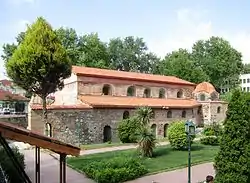
The church of Hagia Sophia was built by Justinian I in the middle of the city in the 6th century.[2] It was in this building that the Second Council of Nicaea met in 787 to end the first period of Byzantine Iconoclasm.
_-_BEIC_6332996.jpg.webp)
A timber-roofed basilica with a central nave and side aisles, it was built shortly after 1065, but extensively remodelled after its conversion into a mosque. Before the remodelling it had two rows of triple arcades on columns that carried a clerestory wall with five windows.[3]
It was converted to a mosque after the fall of the city to the Ottoman Turks in 1337, and functioned as such until it was converted into a museum in 1935. In November 2011 it was again converted into a mosque.[4]
Gallery
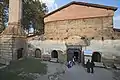 Iznik Hagia Sophia front
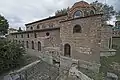 Iznik Hagia Sophia Exterior
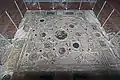 Iznik Hagia Sophia Floor at entrance
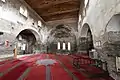 Iznik Hagia Sophia Interior
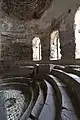 Iznik Hagia Sophia Choir area
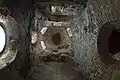 Iznik Hagia Sophia View of interior of secondary dome
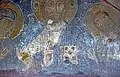 Iznik Hagia Sophia fresco
References
 |
Wikimedia Commons has media related to Hagia Sophia, Nicaea. |
- Smith, William (editor); Dictionary of Greek and Roman Geography, "Nicaea", London, (1854).
- Hazlitt, Classical Gazetteer, "Nicæa"
- Richard Krautheimer, Early Christian and Byzantine Architecture, 4th edition, 1986, p365.
- "The Church That Politics Turned Into a Mosque". International Herald Tribune. 9 February 2012. Retrieved 12 February 2017 – via The New York Times.