Petar Dobrović
Petar Dobrović (Serbian Cyrillic: Петар Добровић; pronounced [pêtar dǒːbroʋitɕ]; 14 January 1890 – 27 January 1942) was a Serbian painter and politician.[1]
Petar Dobrović | |
|---|---|
 A self-portrait from 1932 | |
| President of the Serbian-Hungarian Baranya-Baja Republic | |
| In office August 14, 1921 – August 20, 1921 | |
| Preceded by | office established |
| Succeeded by | office abolished |
| Personal details | |
| Born | 14 January 1890 Pécs, Austria-Hungary |
| Died | 22 January 1942 (aged 52) Belgrade, Territory of the Military Commander in Serbia |
| Nationality | Serbian |
| Relatives | Nikola Dobrović (brother) |
Biography
Dobrović was born in Pécs, Kingdom of Hungary. A proponent of Serbian colorism, he was known for portraits and landscapes. He had earlier worked in impressionism and cubism.
He was briefly the President of a short-lived, small Serbian-Hungarian Baranya-Baja Republic in 1921, and later lived in Kingdom of Yugoslavia.
He died during the German occupation of Belgrade during the Second World War while in the elevator of the apartment building he lived in at 36 King Peter Street during a raid. He noticed the raid on the street and died while attempting to return to his flat. He is interred in the Belgrade New Cemetery.
Gallery
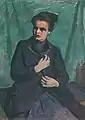 Study for a portrait (1917), Ernest Zmeták Art Gallery
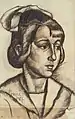 Girl's head (1917), National Gallery of Slovenia
 Figure (1927), Pavle Beljanski Memorial Collection
 Škarpina (1928), Gallery of Fine Arts, Split
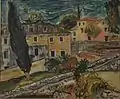 Landscape with Cypresses, Dalmatia (1931), Museum Boijmans Van Beuningen
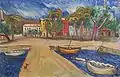 Mlini na jugu (1936)
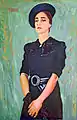 Portrait of Olga Dobrović (1938)
Notes
- Mangold (2005:123, 279 and 624)
References
- Mangold, Max (2005), Das Aussprachewörterbuch, Duden, ISBN 9783411040667
External links
Authority control  |
|---|