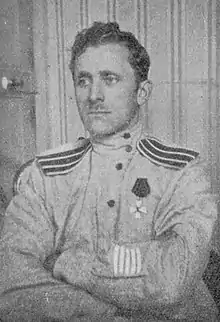
Vasily Pavlov (1895)
Vasily Efimovich Pavlov (March 9, 1895, Smolensk – December 20, 1989, Chelles, France) was a Russian officer, Markovite, lieutenant colonel. Member of the First World War and the Civil War. Member of the White movement in the South of Russia, a pioneer.
Vasily Efimovich Pavlov | |
|---|---|
 | |
| Native name | Василий Ефимович Павлов |
| Born | March 9, 1895 Smolensk, Russian Empire |
| Died | December 20, 1989 (aged 94) Chelles, Seine–et–Marne, Île–de–France |
| Allegiance |  Russian Empire Russian EmpireWhite movement |
| Infantry | |
| Years of service | 1914–1922 |
| Rank | Lieutenant Colonel (1917) |
| Commands held | 7th Officer Company, 5th Company, 3rd Battalion and 1st Officer General Markov Regiment |
| Battles/wars | World War I Civil War |
| Awards | Order of Saint George Sign of the 1st Kuban (Ice) Campaign |
One of the leaders of the Russian General Military Union. Emigrant. Gallipolian. Chairman of the "National Union of Russian Youth" in Grenoble (France). He was the head of the Association of Markovites, a prominent figure in the initial period of the existence of the People's Labour Union, Chairman of the Russian Union of Saint George's Cavaliers, publisher and editor of the military–historical magazine "Communication on Markov's Chains", author of works on the Civil War.
Biography
Born on February 25, 1885 in Smolensk. Graduated from the 1st Smolensk Aleksandrovskoe Real School and the Alekseevsk Military School.
At the front of the First World War since 1914. In 1915–1917, Pavlov fought on the Northwestern and Southwestern Fronts, received several military awards, including the Order of Saint George, 4th Class (the Imperial Order of December 11, 1915), as a second lieutenant of the 24th Infantry General Neverovsky Regiment of Simbirsk.[1] He was wounded three times.
Participation in the Volunteer Army
In the Volunteer Army since the beginning of its creation. Pavlov took part in the First Kuban (February–April 1918) and Second Kuban Campaigns (June–November 1918). On July 13, 1918, he was appointed assistant commander of the 7th Company of the 1st Officer General Markov Regiment. On August 3, he was appointed commander of the 7th Company.
On November 30, in a battle near the village of Konokovka, he was wounded and evacuated for recovery. In 1919 – the commander of the 5th Company of the Officer General Markov Regiment.
After the formation of the 3rd Officer General Markov Regiment – the commander of the 3rd Battalion. From November 14 to December 4, 1919 – interim regiment commander.
Emigration
From 1922 to 1925 he lived in Bulgaria, then moved to France. In 1925, Pavlov joined the Circle of Russian Youth in Bulgaria, in 1926 he headed the Circle of Russian Youth in Normandy. Later – the Chairman of the National Union of Russian Youth in Grenoble. From Germany he was sent as a resident of the People's Labour Union to the city of Lepel (Belarus). During World War II, Pavlov supported the political current within the People's Labour Union, which opposed cooperation with both Hitler and Stalin.
In exile, Pavlov completed the work previously begun by regimental historians on the history of Markov Units. In 1962 and 1964, two volumes were published in Paris: "Markovites In the Battles And Campaigns For Russia In the Liberation War of 1917–1920". The materials of the work were republished in the book "Markov And Markovites".[2]
Last years of life
Vasily Efimovich died on December 20, 1989 in a nursing home in the city of Chelles (France), and was buried in the cemetery of the city of Clichy.
Like many Russian heroes forced to leave their homeland, Pavlov died in poverty. All of his awards and documents, including the archive of the Markov Regiment, were bought by officers of the French Air Force and are probably kept in the museum of the Invalides in Paris.
References
- Index of Names
- "Markov and Markovites" – Moscow: Non–Profit Partnership "Posev", 2001. ISBN 5-85824-146-8
External links
Authority control  |
|---|