1980 South Korean presidential election
Indirect presidential elections were held in South Korea on 27 August 1980 to fill the vacancy caused by President Choi Kyu-hah's resignation.
.svg.png.webp) | ||||||||||||||
| ||||||||||||||
2,540 Deputies of Reunification Assembly 1,271 votes needed to win | ||||||||||||||
|---|---|---|---|---|---|---|---|---|---|---|---|---|---|---|
| ||||||||||||||
| ||||||||||||||
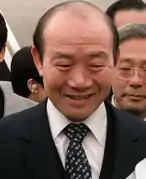
Under the 1972 Yushin Constitution, the president was elected by the National Council for Reunification, whose 2,540 members had been elected for a six-year term of office as part of the 1978 presidential elections. General Chun Doo-hwan was the only candidate, and was elected unoposed.[1]
Chun was to serve for the remainder of the 1978–1984 term of longtime president Park Chung-hee, who had died in 1979 and been replaced by Choi. However, Chun subsequently decided to end the Fourth Republic and draft a new constitution, which was promulgated in October 1980 after being approved in a referendum. The first presidential election under the new constitution was held in February 1981, and Chun was elected by an overwhelming majority.[2]
Background
After the assassination of the military dictator President Park Chung-hee in October 1979, Prime Minister Choi Kyu-hah was elected president in the December 1979 elections. However, General Chun Doo-hwan staged the Coup d'état of December Twelfth and effectively took control of the government, making President Choi a figurehead. However, on 16 August 1980, following the Coup d'état of May Seventeenth, Chun removed Choi from office so he could become president himself.
Results
In order to be elected, a candidate had to receive the vote of over 50% of the incumbent members of the National Council for Reunification. With 2,540 deputies in office, Chun had to receive at least 1,271 votes to be elected. He received 2,524 votes, 99.37% of the total possible.
| Candidate | Party | Votes | % |
|---|---|---|---|
| Chun Doo-hwan | Independent | 2,524 | 99.37 |
| Invalid/blank votes | 1 | – | |
| Total | 2,525 | 100 | |
| Electorate/turnout | 2,540 | 99.41 | |
Electors per region
| Region | Eligible electors | Vacant seats | Total |
|---|---|---|---|
| Seoul | 388 | 3 | 391 |
| Busan | 145 | 0 | 145 |
| Gyeonggi | 315 | 4 | 319 |
| Gangwon | 148 | 3 | 151 |
| North Chungcheong | 129 | 2 | 131 |
| South Chungcheong | 229 | 6 | 235 |
| North Jeolla | 202 | 1 | 203 |
| South Jeolla | 308 | 4 | 312 |
| North Gyeongsang | 367 | 12 | 379 |
| South Gyeongsang | 282 | 8 | 290 |
| Jeju | 27 | 0 | 27 |
| Total | 2,540 | 43 | 2,583 |
References
- Croissant, Aurel. "Electoral Politics in South Korea" (PDF). Friedrich Ebert Foundation. p. 266.
- Editors, History com. "South Korea". HISTORY. Retrieved 2019-03-29.CS1 maint: extra text: authors list (link)
| Presidential elections | |
|---|---|
| Legislative elections | |
| By-elections | |
| Local elections | |
| Referendums | |