Black-bellied thorntail
The black-bellied thorntail (Discosura langsdorffi) is a slow flying species of hummingbird in the family Trochilidae.[2] It is found in Bolivia, Brazil, Colombia, Ecuador, Peru, and Venezuela. Its natural habitats are subtropical or tropical moist lowland forest and heavily degraded former forest at about a 100-300m altitude.[3] It stays high in the forest which explains the lack of scientific information on it.[4] The male will attract the female by fanning out their tail and zooming side-to-side with a loud cracking sound.[2] Generally they'd only make a quick “tsip” or “chip” noise when feeding.[3]
| Black-bellied thorntail | |
|---|---|
 | |
Scientific classification  | |
| Kingdom: | Animalia |
| Phylum: | Chordata |
| Class: | Aves |
| Order: | Apodiformes |
| Family: | Trochilidae |
| Genus: | Discosura |
| Species: | D. langsdorffi |
| Binomial name | |
| Discosura langsdorffi Temminck, 1821 | |
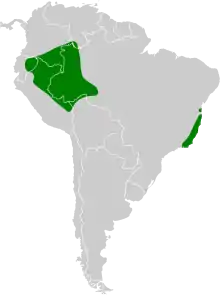 | |
| Synonyms | |
|
Popelairia langsdorffi (Temminck, 1821) | |


This species has a knack for stealing nectar from flowers in other hummingbird territories.[2] Alongside nectar from flowering plants it will hunt for arthropods.[3]
Subspecies
- D. l. melanosternon (Gould, 1868) – S Venezuela and SE Colombia S to E Ecuador, E Peru and W Brazil (R Madeira, R Guaporé, R Negro, W Mato Grosso).
- D. l. langsdorffi (Temminck, 1821) – coast of E Brazil (SE Bahia, Espírito Santo, E Rio de Janeiro).
References
- BirdLife International (2012). "Discosura langsdorffi". IUCN Red List of Threatened Species. 2012. Retrieved 26 November 2013.CS1 maint: ref=harv (link)
- "Black-bellied Thorntail - Introduction | Neotropical Birds Online". neotropical.birds.cornell.edu. Retrieved 26 May 2019.
- "Black-bellied Thorntail (Discosura langsdorffi)". www.hbw.com. Retrieved 26 May 2019.
- "(PDF) Hummingbirds of Santa Teresa, State of Espírito Santo, Southeastern Brazil". ResearchGate. Retrieved 26 May 2019.