East Palace, West Palace
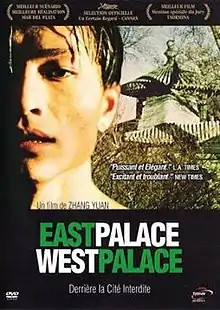
East Palace, West Palace (Dong gong xi gong) is a 1996 Chinese film directed by Zhang Yuan starring Hu Jun and Si Han and based on a short story by writer Wang Xiaobo. It is also known as Behind the Forbidden City or Behind the Palace Gates.[1]
| East Palace, West Palace | |
|---|---|
 | |
| Traditional | 東宮西宮 |
| Simplified | 东宫西宫 |
| Mandarin | Dōng Gōng Xī Gōng |
| Directed by | Zhang Yuan |
| Produced by | Christophe Jung Christophe Ménager Zhang Yuan Willy Tsao |
| Written by | Wang Xiaobo Zhang Yuan |
| Starring | Si Han Hu Jun Zhao Wei |
| Music by | Xiang Min |
| Cinematography | Zhang Jian |
| Edited by | Vincent Lévy |
| Distributed by | Fortissimo Films |
Release date |
|
Running time | 94 minutes |
| Country | China |
| Language | Mandarin |
East Palace, West Palace is the first Mainland Chinese movie with an explicitly homosexual theme.[2] The title of the movie derives from the two parks near the Forbidden City — the East Palace and the West Palace. The two parks, specifically their public washrooms, are notorious for being places of congregation for homosexual in Beijing during the night.[3]
The film was shot in the spring of 1996, when it was smuggled out of China for post-production in France.[2] It premiered at the Mar del Plata Film Festival in Argentina in November 1996 and at the 1997 Cannes Film Festival as part of the Un Certain Regard competition.[4][5]
Plot
In China, homosexuality isn't illegal, but homosexuals are routinely persecuted by police and arrested for "hooliganism". The film focuses on a young gay writer called A-Lan who, being attracted to a young policeman named Xiao Shi, manages to have himself arrested and interrogated for a whole night. His life-story, narrated during the interrogation, reflects the general repression of the Chinese society. Xiao Shi's attitude shifts from an initial revulsion to fascination and, finally, to attraction.
Cast
See also
- Homosexuality in China
- Farewell My Concubine (1993) by Chen Kaige, a story about two stars in a Peking opera troupe, set in mid-20th Century Beijing
- Men and Women (1999) by Liu Bingjian, a story of love resisted and love regained
- Lan Yu (2001) by Stanley Kwan, a story set in modern Beijing with homosexual themes
- Star Appeal (2004) by Cui Zi'en, a gay science-fiction film
- My Fair Son (2005) by Cui Zi'en, a story of a teenage boy in love with an older man
- Spring Fever (2009) by Lou Ye, a story of a love triangle between three young adults
- Bad Romance (2011) by François Chang, a story of the affairs of several young couples in modern Beijing, based on the lyrics of the Lady Gaga song
References
- Van Gelder, Lawrence. "Movies - East Palace, West Palace (1997)". The New York Times. Retrieved 2008-10-24.
- Elley, Derek (1997-05-18). "East Palace, West Palace Review". Variety. Retrieved 2008-10-24.
- Spencer, Charles (20 February 2009). "An erotic relationship of convenience". The Telegraph. London.
- "Festival de Cannes: East Palace, West Palace". festival-cannes.com. Archived from the original on 2012-10-06. Retrieved 2009-09-26.
- Elley, Derek (1997-05-18). "East Palace, West Palace Review". Variety. Retrieved 2008-10-24. and IMDB.com article on release dates.