Front-engine, four-wheel-drive layout
In automotive design, an F4, or front-engine, four-wheel drive (4WD) layout places the internal combustion engine at the front of the vehicle and drives all four roadwheels. This layout is typically chosen for better control on many surfaces, and is an important part of rally racing, as well as off-road driving.
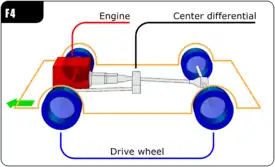
Most four-wheel-drive layouts are front-engined and are derivatives of earlier front-engine, rear-wheel drive, or front-engine, front-wheel drive designs. The 1903 Spyker 60 HP was the first car built with an F4 drive layout.
This layout is also the drive train of choice for off-road pickup trucks and SUVs. It allows these vehicles to get the most traction without sacrificing cargo or passenger room. Part-time four-wheel drive vehicles frequently have a transfer case and no center differential, meaning the 4WD mode does not allow any difference in front and rear axle speeds. For normal road driving, these vehicles are shifted into 2WD mode, to prevent damage to the transfer case. Full-time four-wheel drive systems, on the other hand, cannot do without some kind of center differential. [1]
Examples
 1943 Willys Jeep
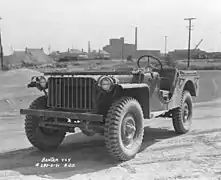 Bantam BRC 40
 Bantam BRC 40, Ford Pygmy
 Dashboard of World War II era jeep
 Jeep with 50 cal. Browning machine gun
.jpg.webp) A Troller T4 Jeep
A Troller T4 Jeep 2008-2009 Jeep Liberty
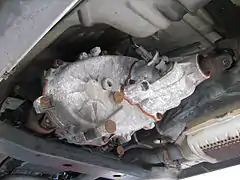 Center transfer case sending power from the transmission to the rear axle (right) and front axle (left)
.jpg.webp) First-generation Dodge Power Wagon
First-generation Dodge Power Wagon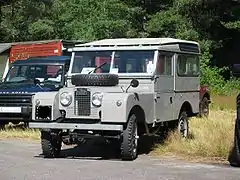 Series I
 Series II 88 in
 Land Rover conversion to fight forest fires, Cascina, Italy (August 2016)