Hibiscus schizopetalus
Hibiscus schizopetalus is a species of Hibiscus native to tropical eastern Africa in Kenya, Tanzania and Mozambique. Its common names include fringed rosemallow,[1] Japanese lantern, coral hibiscus, and spider hibiscus.
| Hibiscus schizopetalus | |
|---|---|
.jpg.webp) | |
Scientific classification  | |
| Kingdom: | Plantae |
| Clade: | Tracheophytes |
| Clade: | Angiosperms |
| Clade: | Eudicots |
| Clade: | Rosids |
| Order: | Malvales |
| Family: | Malvaceae |
| Genus: | Hibiscus |
| Species: | H. schizopetalus |
| Binomial name | |
| Hibiscus schizopetalus | |
Description
Hibiscus schizopetalus is a shrub growing to 3 metres (9.8 ft) tall.
The red or pink flowers are very distinctive in their frilly, finely divided petals.[2][3] Flowers with finely dissected petal have a range of colours, the most common being the red form (Keena et al., 2002; Ng, 2006). Leaves resemble those of H. rosa-sinensis.
The major anthocyanin found in flowers of H. schizopetalus is cyanidin-3-sambusophoroside (Lowry, 1976). From leaves, two new triterpene esters have been isolated (Jose & Vijayan, 2006).
Uses
Cultivation
Hibiscus schizopetalus is cultivated as an ornamental plant,{a kind of shoe flower with dissected petals} for use in tropical and subtropical gardens.
Gallery
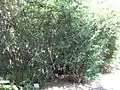 Overall view of Hibiscus schizopetalus shrub.
.JPG.webp) Detail of the end of bloom.
Detail of the end of bloom..jpg.webp) Hibiscus schizopetalus flower in Trivandrum, Kerala, India.
Hibiscus schizopetalus flower in Trivandrum, Kerala, India..jpg.webp) Hibiscus schizopetalus at the Iguazu Falls, Argentina.
Hibiscus schizopetalus at the Iguazu Falls, Argentina.
References
- "Hibiscus schizopetalus". Natural Resources Conservation Service PLANTS Database. USDA. Retrieved 14 May 2015.
- "Hibiscus schizopetalus". Germplasm Resources Information Network (GRIN). Agricultural Research Service (ARS), United States Department of Agriculture (USDA). Retrieved 14 January 2018.
- Huxley, A., ed. (1992). New RHS Dictionary of Gardening. Macmillan ISBN 0-333-47494-5.
- Jose, E.A. & Vijayan, K.K. (2006). “New taraxerane esters from Hibiscus schizopetalus leaves”. Indian Journal of Chemistry, Section B Organic and Medicinal Chemistry 45(5): 1328–1331.
- Keena, C., Yanker-Hansen, K., Marcos Capelini, M. (2002). “Marvellous mallows”. http://www.internationalhibiscussociety.org/hiv1n11-1.htm#1.
- Lowry, J.B. (1976). “Floral anthocyanins of some Malesian Hibiscus species”. Phytochemistry 15: 1395–1396.
- Ng, F.S.P. 2006. “Tropical Horticulture and Gardening”. Clearwater Publications, Kuala Lumpur, Malaysia. 361 pp.
External links
 |
Wikimedia Commons has media related to Hibiscus schizopetalus. |
 Data related to Hibiscus schizopetalus at Wikispecies