Ipomoea calobra
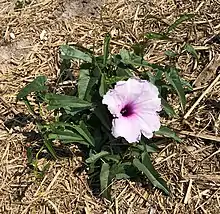
Ipomoea calobra, commonly known as weir vine, is an Australian native plant.[1] It is found in northern Australia, largely Western Australia and Queensland.[2]
| Ipomoea calobra | |
|---|---|
 | |
Scientific classification  | |
| Kingdom: | Plantae |
| Clade: | Tracheophytes |
| Clade: | Angiosperms |
| Clade: | Eudicots |
| Clade: | Asterids |
| Order: | Solanales |
| Family: | Convolvulaceae |
| Genus: | Ipomoea |
| Species: | I. calobra |
| Binomial name | |
| Ipomoea calobra W.Hill & F.Muell. | |
The tubers of this species are edible, being an important source of food (bush tucker) for Indigenous Australians .
It is a creeper growing up to 6 m high, with purple-blue-pink trumpet flowers from January to June. It occurs on undulating plains, dunes, and hardpans in red sandy & clayey soils, and pebbly loam.[1]
References
- "Ipomoea calobra W.Hill & F.Muell. Weir Vine". FloraBase. Western Australian Herbarium. 8 November 1996. Retrieved 14 December 2020.
- "Occurrence records". The Australasian Virtual Herbarium (AVH). Atlas of Living Australia. Retrieved 14 December 2020.
This article is issued from Wikipedia. The text is licensed under Creative Commons - Attribution - Sharealike. Additional terms may apply for the media files.