Road signs in Indonesia
Road signs in Indonesia are standardised road signs similar to those used in other nations but with certain distinctions. As a former Dutch colony, until the 1970s road signs in Indonesia closely followed The Netherlands rules on road signs. Nowadays, Indonesian road sign design are a mix of European, US MUTCD, New Zealand, and Japanese road sign features. According to the 2014 Minister of Transportation's Regulation No. 13 concerning Traffic Signs,[1] the official typeface for road signs in Indonesia is Clearview. Indonesia formerly used FHWA Series fonts (Highway Gothic) as the designated typeface though the rules are not being implemented properly.
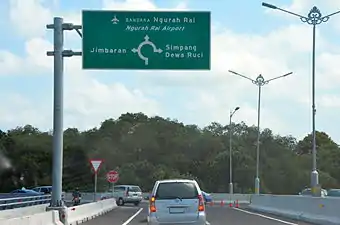
Indonesian road signs use Indonesian, the official and the national language of Indonesia. However, English is also used for important public places such as tourist attractions and airports. Bilingual signs can be found in tourist areas such as Bali.
Indonesia signed the Vienna Convention on Road Signs and Signals but have yet to ratify the Convention.
Warning signs
Warning signs warn of possible dangers or unusual conditions ahead and alert motorists on the hazards to expect. Warning signs in Indonesia used to closely follow US MUTCD and Japanese diamond-shaped with yellow background and black-and-yellow outline but recently they change it to full black outline.
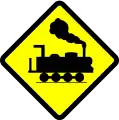 Open railroad crossing ahead
 Railroad crossing ahead
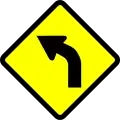 Curve
Curve Double bend
 Sharp turn
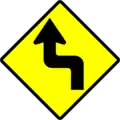 Double sharp turns
 Succession of more than two bends
 270 degree loop
 Road narrow ahead
 Road narrow on right ahead
 Narrow Bridge
 Steep descent
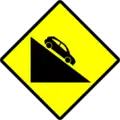 Hazardous descent
 Steep ascent
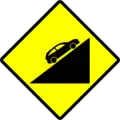 Hazardous ascent
 Slippery surface
 Dip
Dip Bump
Bump Bumpy road
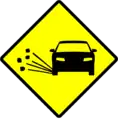 Loose gravel
 Falling rocks
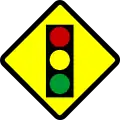 Traffic lights ahead
 Traffic circle
 Start of dual carriageway
 End of dual carriageway
 One-way dual carriageway
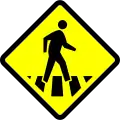 Pedestrian crossing
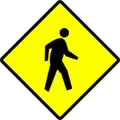 Pedestrian area
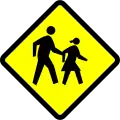 School crossing
 Bicycle zone
 Farm animals crossing
 Wild animals crossing
 Other Dangers (Usually followed with a supplementary sign beneath)
 Roadworks ahead
 Max height ahead
 Max width ahead
 Low flying aircraft
 Cross-wind
 Two way traffic
 Opening or swing bridges ahead
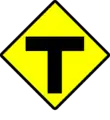
Intersections




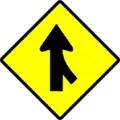







Regulatory signs
Prohibitory signs
Prohibitory signs in Indonesia are circular and have a red border with diagonal bars except for Stop, Yield, and Railroad Crossing signs.
_1a.svg.png.webp) Stop
Stop_1b.svg.png.webp) Yield
Yield Customs post
_1c_(Gerbang_Tol).svg.png.webp) Toll plaza
Toll plaza One-track railroad crossing
 Multiple-tracks railroad crossing
_2a1.svg.png.webp) Do not enter for vehicles
Do not enter for vehicles No motorcycles and mopeds
 No passing
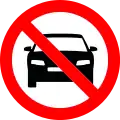 No Vehicles except Motorcycles
 No vehicles (combination)
 No bicycles
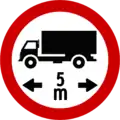 Maximum length for motorized vehicles
 Maximum heigh limit[2]
 Maximum width limit
 Maximum Weight limit
 Maximum Weight limit per axle
_3a.svg.png.webp) No Stopping
No Stopping_3b.svg.png.webp) No Parking
No Parking_4b.svg.png.webp) No left turn
No left turn_4e.svg.png.webp) No U-turn
No U-turn_4f.svg.png.webp) No right turn or U-turn
No right turn or U-turn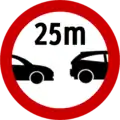 Minimum distance between cars
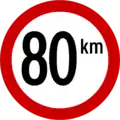 Maximum speed limit in kilometers per hour (km/h)
 Yield to oncoming traffic
_b11a_.svg.png.webp) End of speed restriction limit
End of speed restriction limit
Mandatory signs
Mandatory signs in Indonesia follows the "Type A Mandatory Signs" as prescribed by the Vienna Convention, which is the European-style white-on-blue circular signs with addition of white border
 Follow left
 Follow right
 Turn left
 Turn right
 Go Straight
 Roundabout
 Straight ahead or left turn permitted
 Straight ahead or right turn permitted
_3a.svg.png.webp) Keep left
Keep left Keep right
_3c.svg.png.webp) Pass either side
Pass either side.svg.png.webp) Minimum speed limit in kilometers per hour (km/h)
Minimum speed limit in kilometers per hour (km/h) Tire chain
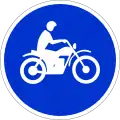 Motorcycle lane
 Buses-only lane
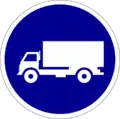 Truck-only lane
_6b1.svg.png.webp) Pedestrians only
Pedestrians only Equestrians only
 Bikes only
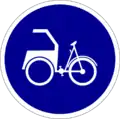 Rickshaws only
 Carts only
 Horse carriage only
 Non-motorized vehicles only
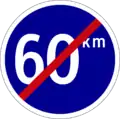 End of minimum speed limit
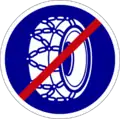 End of tire chain usage
Non-expressway signs
 4-way-intersection directional sign. Ngurah Rai International Airport is highlighted in blue color as it is a public facility
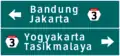 3-way-intersection directional sign. Note the Indonesian National Highway number hexagon
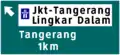 Interchange between tolled interstate highways/turnpikes
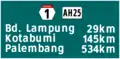 Distance sign, via National Route (different by island)
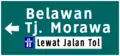 Tolled Interstate hwys/turnpikes entrance
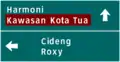 Kawasan Kota Tua, a tourist attraction, is highlighted with brown color
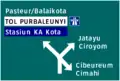 The destination to TOL PURBALEUNYI turnpike is highlighted in white color and bears the international highway symbol, while Stasiun KA Kota, a train station, is highlighted in blue color.
Expressway signs
Most of the signs in this section are custom-made by the tollroad operator and unavailable in the current regulations.
 Expressway Road
 Expressway Road begins
 Expressway Road ends
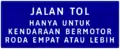 Expressway Road restrictions to non-motorized vehicles ("Expressway Road are only for motorized vehicles with four or more wheels")
 Toll plaza ahead
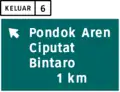 Exit ahead (1 km)
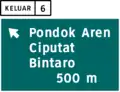 Exit ahead (500 m)
 Exit ahead (300 m)
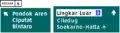 Exit sign (butterfly gantry sign placed in between ramp)
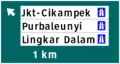 Interchange ahead (1 km)
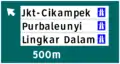 Interchange ahead (500m)
 Interchange ahead (300m)
 Interchange exit
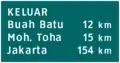 Distance sign, via Toll Road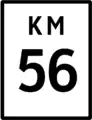
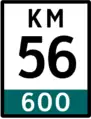 Toll road location marker with meters, placed in each 200m of the toll road
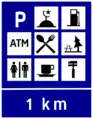 Services area ahead (1 km)
 Services area ahead (500m)
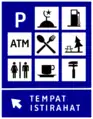 Services area ahead (~300m)
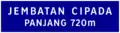 Bridge name
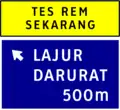 Runaway ramp. The 500m distance is omitted in 300m before the ramp
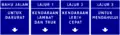 Lane directory
 Advisory sign (Right lane to pass)
 Prohibition sign (Left lane passing is prohibited)
 Distance guidance ahead [3]
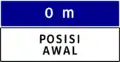 Distance guidance (0m) [3]
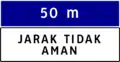 Distance guidance (50m-unsafe distance) [3]
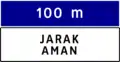 Distance guidance (100m-safe distance) [3]
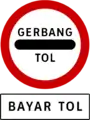 Toll plaza (pay toll)
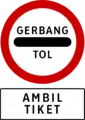 Toll plaza (take ticket)
 Toll plaza (electronic payment)
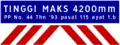 Toll plaza height limit [2] (might be omitted in some toll plazas)
 Warning sign (Fog)
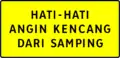 Warning sign (Sidewind)
Information signs
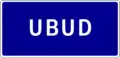 City limits
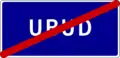 City limits
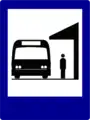 Bus terminal
 Train station
 Harbor
 Airport
 Garbage/Waste disposal
 Landfill
 Post office
 Payphone
 Bus stop
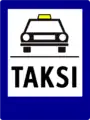 Taxi stand
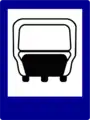 Public transport stand apart from buses and taxis
 Crosswalk
 Parking permitted
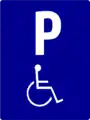 Parking permitted for wheelchair
 Tunnel
 End of tunnel
 Tsunami evacuation route
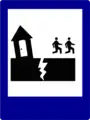 Earthquake evacuation route
 Volcano eruption evacuation route
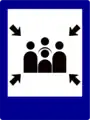 Emergency muster zone
 Refuge camp
 Refuge center
 Mosque
 Church
 Vihara
 Hindu Temple
 Hospital
 Clinic, Community Health Center
 Pharmacy
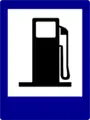 Gas station
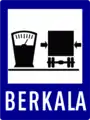 Scheduled service station
 Emission service station
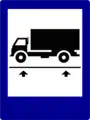 Weigh station
 Museum
 Market
 Restaurant
 Café
Café Lodging
 Motor services
 Park
Park Cross-country route
 Tent camp
 Caravan camp
 Camp
Camp Villa
Villa Beach
Beach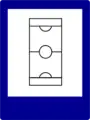 Open sports field
 Indoor sports center
 Swimming pool
 Stadium
 School
 Library
 One way
 Dead end
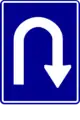 U-turn area
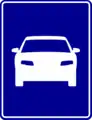 Motorized vehicles only
Temporary signs
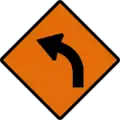 Curve left
 Curve right
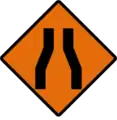 Road narrows
 Road widens
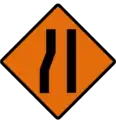 Narrow left
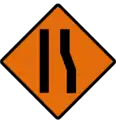 Narrow right
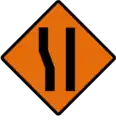 Widen left
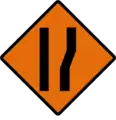 Widen right
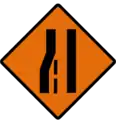 Lane reduction on left
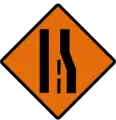 Lane reduction on right
 Lane addition on left
 Lane addition on right
 Certain road narrowing
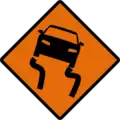 Slippery road
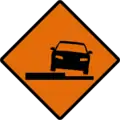 Uneven surface
 Gravel
 Diversion to the right
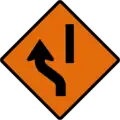 Diversion to the left
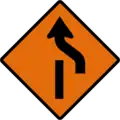 Diversion ends to the right
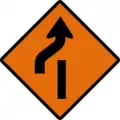 Diversion ends to the left
 Diversion by division
 Diversion by division ends
 Diversion by division (Different traffic flow)
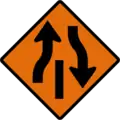 Diversion by division ends
 Warning sign (followed by a supplementary sign beneath)
 Road works
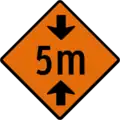 Maximum height
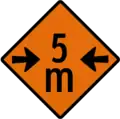 Maximum width
 Two-way
 Traffic control by officers on work
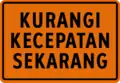 Worded warning sign (in this case "Reduce Speed Now")
See also
References
- http://hubdat.dephub.go.id/km/tahun-2014/1626-peraturan-menteri-perhubungan-nomor-pm-13-tahun-2014-tentang-rambu-lalu-lintas/download
- Indonesian vehicle maximum height standard, according to Article 54, Paragraph (1)c of the Indonesian Republic Government Regulation No. 55 of 2012 (shown in regulations as in milimeters, and height should not exceed 1.7 times vehicle breadth)
- Only found in the Jagorawi and the Jakarta-Serpong toll road
Road signs in Asia | |
|---|---|
| Sovereign states |
|
| States with limited recognition |
|
| Dependencies and other territories |
|
| |


